Monday, February 20, 2012

President's Day

Seeing that today is President's Day, and due to a recommendation from my friend Scott, I decided to take a look at JFK's inaugural address.  The climate in which JFK took office is not unlike our own.  The world was a tumultuous place in 1961; arguably it was one of the most dangerous periods in American history.  I will venture to say that it was more dangerous than it is now.
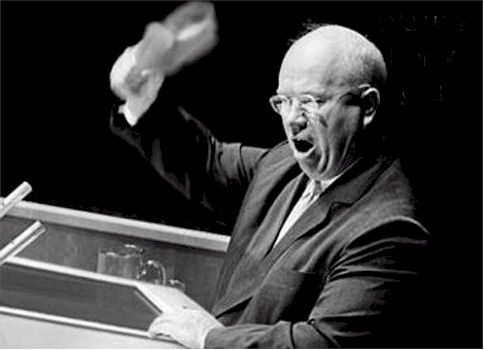
Khrushchev famously slamming his shoe on the podium at the UN

The Soviet Union was at the height of it's power; Nikita Khrushchev scared the crap out of Americans.  The Civil Rights movement was just taking shape. Nuclear fear gripped America from "duck and cover" to the construction of fallout shelters nationwide.
Bert the Turtle: "Duck and Cover"

In the mire of fear surrounding the decade, a young Senator from Massachusetts was elected to the highest office in the country.  His first words to our nation were not of fear; they were words of hope and came with a promise: a restoration of American values.

"The world is very different now. For man holds in his mortal hands the power to abolish all forms of human poverty and all forms of human life. And yet the same revolutionary beliefs for which our forebears fought are still at issue around the globe—the belief that the rights of man come not from the generosity of the state, but from the hand of God.

We dare not forget today that we are the heirs of that first revolution. Let the word go forth from this time and place, to friend and foe alike, that the torch has been passed to a new generation of Americans—born in this century, tempered by war, disciplined by a hard and bitter peace, proud of our ancient heritage—and unwilling to witness or permit the slow undoing of those human rights to which this Nation has always been committed, and to which we are committed today at home and around the world."

Today, we still hold the power to help all men, and we still have the power to wipe all life from the face of our planet.  We know our rights come from our existence, but many amongst us have bought into the fear of the modern world. People have sacrificed our rights for the government's "security". 

Now, there is a new generation coming of age; we are the heirs of bad policy, spiraling debt, a forgotten constitution, and a crumbling empire. We have been tempered by 11 years of war.  We have been disciplined by the hard and bitter peace of the 90's. We are more proud than ever of our heritage because our government has forgotten it. We want the torch to be passed to us, and with it we will reignite the dwindling fire of liberty, not only in the American spirit, but in the whole world.

"In your hands, my fellow citizens, more than in mine, will rest the final success or failure of our course. Since this country was founded, each generation of Americans has been summoned to give testimony to its national loyalty. The graves of young Americans who answered the call to service surround the globe.

Now the trumpet summons us again—not as a call to bear arms, though arms we need; not as a call to battle, though embattled we are—but a call to bear the burden of a long twilight struggle, year in and year out, "rejoicing in hope, patient in tribulation"—a struggle against the common enemies of man: tyranny, poverty, disease, and war itself.

Can we forge against these enemies a grand and global alliance, North and South, East and West, that can assure a more fruitful life for all mankind? Will you join in that historic effort?

In the long history of the world, only a few generations have been granted the role of defending freedom in its hour of maximum danger. I do not shrink from this responsibility—I welcome it. I do not believe that any of us would exchange places with any other people or any other generation. The energy, the faith, the devotion which we bring to this endeavor will light our country and all who serve it—and the glow from that fire can truly light the world.

And so, my fellow Americans: ask not what your country can do for you—ask what you can do for your country.

My fellow citizens of the world: ask not what America will do for you, but what together we can do for the freedom of man."

It is the last two sentences that are most forgotten today. Americans expect the government to be the creator of jobs, the guarantor of economic survival, and the defender of liberty. The governments track record in all of those endeavors is, quite frankly, terrible.

Citizens have come to expect their existence to originate from their government, and the government has come to expect itself to do the same. Most people know that second-to-last sentence: "ask not what your country can do for you, but what you can do for your country".  Yet few believe it.

Even fewer know the last line: "ask not what America will do for you, but what together we can do for the freedom of man." Many states in the world have come to expect America to be there for them, to protect them with our hot lead umbrella. They have intentionally allowed their own defenses to be weakened to the point that now, should a conflict arise, they are hopelessly unprepared. They join with us, not because they wish for the freedom of man, but because we have subsidized their right to exist.

Americans, today, we need another John F. Kennedy.  We need a President who is fearless, but not reckless.  Who is impatient, but not permissive. A president who leads from the front with support from all walks of life. Most importantly we need a President who truly believes in the value of the individual, because from the individual will stem all successes and failures of our species.

Tuesday, February 14, 2012

Did the Great Game ever end?

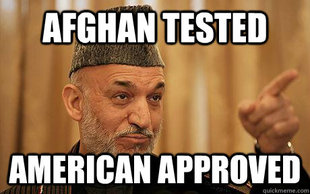
For those unfamiliar with the history of Afghanistan (as most Americans are) the US-led coalition and Hamid Karzai's "Afghan tested, American approved" government are not the first time a greater power has attempted to control the region for political supremacy.

We've all heard the statement that "the third times a charm", but in the case of our coalition it's more like the 4th or 5th time is a charm.  In fact, only one person ever successfully conquered and held Afghanistan: Genghis Khan, all way back in 1219AD.

Afghanistan's high point of regional power came in the early 18th century, when, after expelling their Persian leaders (the 1st failed foreign occupation), they attempted to conquer India and were subsequently expelled by the Sikhs.

Coinciding with this, the empires of Great Britain and Russia hit a phase of rapid expansion.  Great Britain acquired many of it's colonial holdings, most notably India.  Russia expanded from the Baltic, to the Black and Caspian Seas, across the endless Siberian steppe, eventually to the Pacific.  This placed Afghanistan and most of Central Asia in the sights of the two superpowers.  Afghanistan was seen by Great Britain as the path of least resistance to it's Indian holdings; likewise, the Russians saw Afghanistan and Central Asia as buffer states along their massive border to prevent British expansion into the Russia's open, exposed prairie.

With the onset of the First Anglo-Afghan War, the Great Game began.  After the initial invasion, a puppet government was installed, but after a few years mobs on the street were attacking any European they could find.  The military garrison and government was driven out and completely decimated in their retreat back to India. (2nd failed foreign occupation)

Then came the Second and Third Anglo-Afghan Wars. Each were minor victories for Britain, but only because they learned from their first experience in the Kush Mountains. They did not occupy the country. The second war allowed Afghanistan to retain it's government, but it lost control of it's foreign policy; the third saw control of foreign policy returned to the Afghans. Instead of wasting man power trying to occupy and hold Afghanistan, the British set it up as a buffer state to Russia.

With the onset of World War I and the rise of Bolshevism the Great Game ended... or at least that's what most historians think.  I believe it was postponed and the rules were altered a little.  The United States began to play alongside Great Britain and the Soviet Union replaced Imperial Russia.  The Great Game resumed with George Kennan's X article; only the name of "the Great Game" was changed to "containment policy" (...the Great Game sounds better, doesn't it?).

Afghanistan was left out of the new Great Game for the better part of the twentieth century, until 1979 when the Soviet Union invaded to promote the growth of the fledgling People's Democratic Party of Afghanistan.  The Soviets were there for ten years, spending billions and killing millions.  And for those familiar with US policy, we funded the fight, supplying the mujahedeen with funding, advanced weapons, and training.  The funding continued until the Soviet withdrawal in 1989. (3rd failed occupation)

In the time between 1989 and 2001 Saudi Arabia and Iran backed opposing sides in a civil war to establish regional hegemony.  It was a costly and bloody fight, coming right on the tales of the Soviet Occupation.  This made the country extremely weak. So, over the years, Afghans who trained in Pakistan made their way back into the country and consolidated power, calling themselves the Taliban.

Now I should not have to explain anything past 2001. I'm pretty sure that being in the Kush Mountains eleven years and spending trillions on the Afghan Money Pit has, at least, shown Americans that our great building project isn't really working as intended.

Really what I want to know is why we thought we could do it.  We've all heard the adage that those who don't examine history are doomed to repeat it.  Every modern nation that has invaded Afghanistan before the US-led effort failed, spending themselves into oblivion while trying to maintain a valueless land area.  There are no major resources or ways to gain revenue in Afghanistan, and I'm sure that the people there, having been in a constant war since 1979 (or 33 years), would much rather be left to their own devices. No bureaucrat in London, Moscow, or Washington can understand the way this ancient nation functions, nor should they try to bend the Afghan people to their will.  It is clear that we are not wanted, as it was clear the Soviets were unwanted, as with the British and Persians before.  The people of Afghanistan want the same things we all do: a home, a family, a job.  A foreign government can not adequately provide those things, and history shows that it is completely foolish to try.

A final item of some importance: what happened to the governments of Persia, the Soviet Union, and Great Britain after failing in Afghanistan? Persia descended into anarchy because the Afghans killed the Shah. The Soviet Union went completely bankrupt and collapsed in 1991. Great Britain had the only positive outcome. After learning from their first mistake that occupation was foolish; they left Afghanistan to govern itself issuing in a period of peace in the region.

Friday, February 3, 2012

On the Balance of Threat Theory

In 1985, Stephen M. Walt (from Foreign Policy and The Israel Lobby and US Foreign Policy) published an article in International Security titled "Alliance Formation and the Balance of World Power".  Speaking to idea that states either balance --join with another state against a growing threat-- or bandwagon --join with the threat to guarantee survival--, Walt's theory of international relations (IR), now called Balance of Threat theory, postulates that 4 distinct threats shape alliance formation in IR:

1) Aggregate Power- total combined resources of a state greatly exceeds others
2) Proximate Power- location of a threat shapes alliances for neighboring states
3) Offensive Power- military capabilities of a state
4) Offensive Intentions- an aggressive/expansionist foreign policy

When these threats are applied to the balancing/bandwagoning argument Walt proposes two different hypotheses:

Balancing- "If balancing is the dominant tendency [in IR], then threatening states will provoke others to align against them... Credibility [of allies] is less important in a balancing world because one's allies will resist threatening states out of their own self-interest, not because they expect others to do it for them."

Bandwagoning- "If states tend to ally with the strongest and most threatening state, then powers will be rewarded if they appear both strong and potentially dangerous. International rivalries will be more intense, because a single defeat may signal the decline of one side and the ascendancy of the other... Moreover, if statesmen believe that bandwagoning is widespread, they will be more inclined to use force to resolve international disputes. This is because they will both fear the gains that others may make by demonstrating their power or resolve, and because they will assume that others will be unlikely to balance against them."

Following this, Walt goes on to say that, historically, balancing is the norm (example- France/Russia vs. Germany/Austria-Hungary in WWI); however, bandwagoning occasionally occurs (example- Finland/USSR during the Cold War).

The balance/bandwagon argument becomes complicated with the addition of ideology. In much political rhetoric, especially during the Cold War, ideological birds of a feather, indeed, flocked together; yet, through the examples of international communism and pan-arabism Walt also notes that birds of a feather can fly apart:

International Communism supposed that Moscow was the vanguard, and it exercised it's global influence accordingly; however, as China became more powerful it began to break away from Moscow's influence culminating in the Sino-Soviet split. In Yugoslavia, Tito also split from the Soviet Union with the idea that there are many roads to socialism.

Likewise Pan-Arabic ideology, despite the obvious cultural commonalities between middle eastern countries, could never really take off.  Pan-Arabism required states to relinquish their power to become part of the larger picture, but the problem was to whom would power be relinquished? Nasser's Egypt or Saddam Hussein's Ba'athism?  In the end no consensus was reached, and with Nasser's death the experiment also died.

I wish to apply the two above examples to our modern international climate.  More specifically, I want to address how the United States, by subsidizing the defense of Europe with NATO, has elicited a bandwagoning response by EU nations and others.  I must give credit to Walt in his assertion that balancing against power is the historical norm; however, norms do change with time. Starting in 1945 through the collapse of the Soviet Union to present, bandwagoning has been the normal response to the United States in it's alliances.

Much of this argument extends from other portions of Walt's paper.  He cites "bribery" as a leading cause for states to form/remain in alliances.  To quote Walt on bribery, "the provision of economic or military assistance will create effective allies, either by demonstrating one's own favorable intentions, by invoking a sense of gratitude, or because the recipient will become dependent on the donor." He goes on to highlight the big problems with buying allies:

1) That in a world with multiple superpowers a recipient who is displeased with the aid it is receiving can get it elsewhere.
2) Recipients will try harder to get more aid because they are weaker than the one providing it, and if the provider feels that stopping the aid will lead to vulnerability, they are more reluctant to cut the funding.
3) The more important the ally is to the provider; the more aid it will receive. This gives the smaller state a substantial advantage for bargaining when it knows it's own importance.
4) By providing aid, the weaker state gains more strength and, eventually, has less need to follow the provider's wishes.

Throughout the Cold War, the United States was the sole protector of Europe.  At the time it made sense for the United States, being relatively unscathed by the second world war, to defend Europe.  It allowed European nations to place a limited amount of resources in defense spending freeing up the funds for rebuilding their economies.  It made the dollar, based on gold, the international standard, propelling the US to new heights of wealth and prosperity.  Finally, it took away much of the perceived threat from the Soviet Union because, if one American were killed, it would be all out war.

However, the collapse of the Soviet Union and the Warsaw Pact left NATO in an identity crisis.  It's use as a balancing force against the Warsaw Pact ended. So instead of completely restructuring itself, allowing the EU to take over the function of collective defense; it expanded becoming an offensive instrument of Washington's foreign policy with Europe bandwagoning because of dependence.

This can be seen by NATO's roll in Afghanistan. If troop commitments to a conflict are taken as a test for bandwagoning behavior in an alliance, coalition forces that are not US military personnel account for a minimal number of soldiers on the ground. As of 6 Jan 2012, 90,000 (69%) of the total 130,386 soldiers in the ISAF are US forces. That means the remaining 40,386 (31%) of the total are from the other 49 nations in the coalition. Naturally many of these nations can not afford to contribute more; they are artificially weak from dependence on American personnel for 67 years.

In the Korean War 341,600 men made up the United Nations Security Council force; 300,000 (88%) were US personnel. In Vietnam the total international troop count was 601,100; of this, 536,100 (89%) were US personnel. In both cases, the governments of Europe bandwagoned with the US as it balanced the communist threat on their doorsteps.  With the removal of that threat in 1991, international support for US foreign policy objectives has plummeted.

This is where the failed examples of bribery --international communism and pan-arabism-- enter the discussion.  When subordinates of the Soviet Union or unified Arabic states had enough power to "fly apart" or step out of line with the ideological leader, they did.  That split is happening with our allies now.

Despite the economic woes of the Eurozone, the EU economy remains larger than that of the United States. According to the 2011 CIA World Factbook, the EU's economy is 15.39 trillion dollars compared to the United States' $15.05 trillion. Without threat from communism they no longer need us, the only reason we have not yet fully lost their support is because we give them a free ride on defense spending.  In order to be a member of NATO, states are supposed to spend 2% of their GDP on defense.

In a 2011 article to The Daily Caller, the Cato Institute's Ted Carpenter highlighted the problem caused by bribing Europe:

"...even before the economic crisis led to drastic budget slashing, spending levels in several countries (including such major allies as Germany and Italy) were closer to one percent of GDP than two. And matters have gotten worse in the past two years. The $700 billion US defense budget now accounts for an astonishing 74 percent of total spending by NATO members.  The other 26 members of the alliance spend a mere $220 billion-- despite having a collective economy larger than that of the United States."

So, if Europe bandwagons with the United States because of dependency, and if we believe Walt's theory that a bandwagoning world is substantially less safe than a balancing world, then we must evaluate whether NATO is costly or beneficial to the United States.

As seen above, financially, it is not. And in these economic dire straights, that reason should be paramount. Beyond that and within the last two years, we have also witnessed a new phenomenon: Europe championing regime change, but expecting the United States to fight the battle, as was the case in Libya and will soon be the case in Syria. Yes, in each case the leaders are/were terrible men; however, if Europe wants the fight so bad, let them do it without our help.  The United States needs to get its economic house of cards in order domestically before spending itself into oblivion by policing the world.  Moreover, (and repeating Walt's argument) if we really want a safer world, we need to let our birds fly apart.

One would think that this is easier said than done, but really it could be accomplished fairly easily keeping Europe safe and allowing the US economy to recover.  The biggest problem is appeasing our own Military Industrial Complex (MIC), but even that can be done.  If we sold our European bases, and their subsequent fighter/bomber/support wings this whole problem would be solved.  The aircraft we field in Europe are all outdated, built in the 70's and 80's.  However, each year we spend billions refitting and updating them.  If Europe took over their maintenance, then the MIC would be satisfied as they would still receive revenue for parts and maintenance.  Europe would be safe because all of a sudden it would have it's own military capabilities again.  The United States would be more secure economically, and again, the MIC would be satisfied because we could focus efforts at home on building more advanced aircraft, making our own nation even safer than it is now.  We would not necessarily have to leave NATO, but our membership as well as Europe's would finally reach a point of balance and safety for the first time in 67 years. This is the logical step, and one that should be taken before our house of cards collapses.
Tuesday, January 31, 2012

Droning on and on...

Tonight, in a Google+ "hangout" with the American People, our tech President confirmed the use of unmanned aerial vehicles (UAV's) in Pakistan's tribal regions.  This news is obviously no surprise, these strikes have been going on for years, and will continue for years to come.

This post is not as much about the President confirming our covert war in Pakistan as it is about the use of drones worldwide.  UAV's are remarkable weapons that are a tremendous benefit to our soldiers in combat.  They provide realtime intelligence to men on the ground, can fire on enemies with 1000lb guided bombs, can laser designate targets for larger air strikes, and can track multiple individuals simultaneously all while keeping the pilot safe in a warehouse somewhere in America's heartland. The technology is pretty damn incredible.

However, what implications do our use of drones beyond the combat zone have on our foreign policy?  Let's play devil's advocate for a moment:

Imagine that a radical Canadian terrorist group -L'Maple Leaf- flew a passenger jet into the Kremlin.  Russia declared war on Canada and has been caught there for ten years.  A large number of Canadians fled to Minnesota and are slowly funneling weapons and supplies back to Canada to fight for a restoration of their sovereignty.  It's been nearly impossible for the US to adequately manage Minnesota because of the large influx of refugees from neighboring Canada.  Russia has agreed to give the US money in return for flying drones in Minnesota.

You are a cab driver in Minnesota. You have a wife, two kids, mother and father, and a pretty comfortable life.  One day you pick up a man, he is running late to his daughter's wedding.  You get him there as quickly as possible.  He is so grateful for your talented driving that he invites you in for the ceremony (and the open bar, which is the best part anyway).  You go in, there is music, dancing, everyone is happy... but you did not know one important detail... that a member of L'Maple Leaf, whom Russia is tracking,  was also in attendance then...

FLASH the building is gone. You are alive but severely burned.  The children you saw playing, the people dancing, the bride and groom, all lie dead.  Burned, bleeding body parts lie strewn about like leaves in fall.  It's nearly impossible for you to move. You're taken to a hospital; you have to pay for your treatment.  Russia pays no restitution and insists that they are taking the necessary steps to keep Minnesota, as well as Canada and Russia, safe. You decry your government for allowing this violation of sovereignty; you demand payment for your bills, but nothing comes.  Finally, the US does complain, so Russia cuts off most of the aid money they were paying to intervene in Minnesota.  The aid stops, but the overflights do not.  Each day more of your fellow Minnesotans are killed for simply being in the wrong place at the wrong time. With the US failing to act, with the bombs still falling, and with outrage constantly growing you decide it's time to act.  You take up arms with L'Maple Leaf, not out of any ideological reason, not because you want to keep your way of thinking, but because your home, family, and nation are all at stake.  Does that make you a terrorist or a freedom fighter?

So go back and replace "US" with Pakistan, "Russia" with United States, and "L'Maple Leaf" with Al Qaeda/Taliban.  Can we really sit here in the comfort of the most powerful, prosperous society in the world and scratch our heads when we hear about Pakistani anger with the United States? We refuse to take a walk in their shoes; we refuse to imagine what it would be like to live in constant fear of patrolling aircraft; we lack the capacity to understand someone who is not us.  If my devil's advocate scenario above was actually happening I can tell you without a doubt that I would be a "terrorist" (but I would know I was a "freedom fighter").

Wednesday, January 25, 2012

Ayn Rand and the Prophesy of Atlas Shrugged

I recently had the privilege of seeing Ayn Rand and the Prophesy of Atlas Shrugged in theaters a few days ago.  It is a full length documentary that discusses the "prophesy" of the novel; the prophesy being that government regulators and crony capitalists will destroy the United States.  The film likens todays society with its floundering bureaucracy and uncontrollable debt to the dystopia presented in Rand's masterpiece; the resemblance is uncanny.

If you have read Atlas Shrugged before this movie is a must see.  If you have not read it; go pick up a copy, read it, then go see the film.  The movie is not called "objectivism for dummies" so familiarizing yourself with Rand's themes before hand comes in really handy, and to be honest, no film is better than its paper counterpart.  Don't let the staggering 1,250 pages intimidate you either.  Yeah it is really long... but you will thank me when you're done reading it, I promise.

So how does the prophesy of Atlas Shrugged tie into this blog?  Foreign policy is only briefly discussed by Rand; however, the one foreign policy item she talks about in detail -foreign aid- is incredibly important.  As Mary Beth Sheridan noted last year in the Washington Post:

"President Obama's 2012 budget proposal says that funding for the State Department and U.S. Agency for International Development (USAID) would increase only 1 percent over 2010 levels, to $47 billion. But that's not the whole picture.

The document would move funding for Iraq, Afghanistan and Pakistan into a separate account, for "Overseas Contingency Operations," following the practice of the Department of Defense. Taken together, the two accounts would represent an 8 percent increase for the State Department and USAID over the 2010 budget--or total spending of nearly $58 billion.
$58 billion of our money; our taxes.  In harsh economic times we should not be handing out cash like candy on halloween.  The goals of USAID sound so great: combating HIV/AIDS, feeding the hungry, clean water, etc... but why is the government doing it? Aren't there some fantastic NGO's already doing the same thing? (Doctors Without Borders, Amnesty International, the International Red Cross, etc...) These NGO's only receive funding out of the kindness of people's hearts, and they do not give the support with conditions (like Anti-Terrorist Certification).

I've often heard the argument that "we're the wealthiest nation in the world, so we can afford to give to others." But there is a tremendous flaw within that statement: we are not the wealthiest nation in the world; we just have the wealthiest citizens.  There is nothing wealthy about -$15,000,000,000,000 of national debt.  Take the $58 billion spent annually on USAID and use it to fix problems here!  The infrastructure of our country is rotting (currently we have a D on our infrastructure report card).  This has led to problems like bridge and levee failures, and the problem will only get worse.  Though it may sound counter-intuitive to encourage more spending after I just criticized our national debt, an initial investment in infrastructure secures our future for years to come.  It will make more citizens wealthy, it will create jobs, and it will allow people to donate to organizations that promote humanitarianism for the sake of humanity, not politics and influence.

We [to paraphrase Margaret Thatcher] are succumbing to the common socialist dilemma: we are running out of everyone's money.  The last thing I will leave you with is a quote from Atlas Shrugged.  It is the theme of the novel, and it is the prophesy Rand made for our nation:

"The great oak tree had stood on a hill over the Hudson, in a lonely spot on the Taggart estate. Eddie Willers, age seven, liked to come and look at that tree. It had stood there for hundreds of years, and he thought it would always stand there.  It's roots clutched the hill like a fist with fingers sunk into the soil, and he thought that if a giant were to seize it by the top, he would not be able to uproot it, but would swing the hill and the whole earth with it, like a ball at the end of a string. He felt safe in the oak tree's presence; it was a thing that nothing could change or threaten; it was his greatest symbol of strength. 


One night, lightning struck the oak tree. Eddie saw it the next morning. It lay broken in half, and he looked into its trunk as into the mouth of a black tunnel. The trunk was only an empty shell; its heart had rotted away long ago; there was nothing inside -- just a thin gray dust that was being dispersed by the whim of the faintest wind. The living power had gone, and the shape it left had not been able to stand without it."

Tuesday, January 17, 2012

A Brief Complaint

Last night, the Grand Ol' Party slugged it out in Myrtle Beach, SC. While answers were largely unsatisfactory across the board, I wish to briefly discuss one thing:

Why was Ron Paul booed for citing the "golden rule" in reference to American foreign policy?

In such a predominantly christian place as South Carolina, one would think that the idea of treating people as you would like to be treated would carry resoundingly in the audience.  In fact, the opposite happened. I'm pretty sure that Jesus did not say that "do unto others as the United States sees fit".

This pervasive lack of respect for non-Americans or our "American exceptionalism" should frighten us. It is the reason why nations fear us, but do not respect us. Even though Teddy Roosevelt said to carry a big stick; he also said to walk softly. We have forgotten how to walk softly, how to show respect to others, and most importantly, how to respect our own constitutional values.

The people in that room, the ones who disagreed with Congressman Paul's assertions, have forgotten the roots of our nation.  Yes we, as a nation, were born of a war.  But war is not, and should never be our national agenda. Our track record is hurting any diplomatic endeavor we undertake be it anti-missile defense or trade agreements.  It is no surprise that nations are hesitant to enter into contracts with us; we do not respect our counterparts.  We walk loudly with our big American stick, and flip the bird to people who disagree. That policy, that as Americans we know best for the world, DOES NOT WORK. It hasn't worked since 1945, and it will continue to fail.  The only reason it has not yet happened is because we still have the biggest stick in the room.

Wednesday, January 11, 2012

Is war with Iran really a good idea?

I feel like I should not have to ask that question, but the more I speak with people, the more a favorable opinion of intervention arises. You hear all the same arguments from the Iraq War: What if they get a nuclear bomb? What about our ally, Israel? What about oil security? They support terrorists/they are a terrorist state.

 I will answer all of these arguments, and make a case for why war with Iran is a terrible idea. But first, let's look briefly at the history of modern Iranian-American relations. I recently saw a brilliant video about this on youtube. As the video explains, the current spat between the United States and Iran did not begin, as most believe, with the 444 day long Iranian Hostage Crisis, but instead in 1953 when the United States overthrew the government and installed a dictator (as we have done in more than 20 other nations since 1945). While this video makes a compelling case about the history of the dispute and it's true causes; it does not address most modern american's reasons why they think war is a great idea. I'm going to start with the most obvious concern:


What if they get a nuclear bomb?
The real question is not if they will get one, but if their acquisition of a bomb is really a bad thing. I believe that a nuclear Iran could be very stabilizing for the entire Middle East. Much like Europe at the end of the Second World War there is, as of now, only one nuclear power in the region. The United States greatly feared the Soviet Union getting a bomb, but once they had it and after the initial panic caused by the Soviets getting it, the Cold War stayed cold. Currently, Israel is the only nuclear power in the region; it is an advantage they definitely do not want to lose. Practically speaking, a nuclear war between Israel and Iran is completely impossible, especially because of the theocratic government in Tehran. All of Islam's holy sites other than Mecca are located in Jerusalem. A nuclear attack on Jerusalem itself would destroy all of those sites, bringing massive anger from Islamic populations worldwide. So no nuke in Jerusalem. What about other leading population centers: Tel-Aviv,Beersheeba , or Rishon LeZion. While these places could be destroyed without harming holy sites, another huge factor comes into play. Fallout. While the distance fallout travels varies due to wind and the type of radioactive isotopes, it can still travel a long way. This places neighboring countries (including allies of Iran) at major risk. Syria, Lebanon, Jordan, the Gaza strip, and their populations would all be at risk of contamination. Therefore, Israel cannot be attacked. What about the United States? Firstly, Iran does not have the capabilities to strike the United States or it's territories by conventional means (like a missile); even if they did have a missile we have such incredible missile defense systems that it would likely take hundreds of independent warheads to slip through the safety net. The only other way a nuclear bomb could enter the United States would be through smuggling, and even if they somehow made it through the countless radiation detectors at a port or in an airport the relative impact of a single devise (though incredibly tragic) would be small. The type of bomb allegedly being developed by Iran is very small compared to what is in our arsenal, and it's blast radius would likely be similar to that of Hiroshima meaning that even in an incredibly dense population area there would be much less death and destruction than the bombs we would immediately drop on Iran. Which brings up my final point on this subject: Using a nuclear bomb would be an act of national suicide. The entire Iranian population would be eliminated in the matter of about 5 minutes. One American "Peacekeeper" missile drops ten 300 kiloton hydrogen bombs (for comparison "Fat Man", the bomb dropped on Hiroshima, was 21 kilotons). The entire country would be turned to glass.


What about our ally, Israel?
This is a fair question given the incredibly deep ties our nations have with each other, but there are some very practical points that need to be considered. The first being "should our support be unconditional"? No, it definitely should not be. I certainly do not wish to be drafted into a war that was not started by us and especially when we were not attacked. The "logic" of unconditional support is what started World War I, and was the reason it was such a bloodbath. Another thing to consider is Israel's own military capabilities. They are incredibly talented in combat, and have successfully defended their nation on numerous occasions. Also, as mentioned above, they are a nuclear power. The fact stands that Israel does not really need our unconditional military protection. I have no problems standing with them diplomatically, but if Israel were to be the aggressor in a conflict that support would be morally wrong.


What about oil security?
This question has been the most recent one to arise because of threats to close the Straight of Hormuz. Like using a nuclear bomb, this move would also be national suicide. However, instead of being physical it would be economic suicide. 50% of China's oil comes from Iran and passes through the Straight. China is already the second largest consumer of oil in the world, and they certainly would not stand losing half of that. Oil prices worldwide would skyrocket, and odds are that both China and the United States would strike to reopen the supply route. Also, Iran produces 4.252 million barrels of oil a day. At a market price of $101/bbl that is equal to a daily profit loss of almost $430 million a day if the straight were to close. In all, threats to close the Straight are completely hollow threats, and should not be taken seriously at all.


They support terrorists/are a terrorist state
This may be true, but it is not a cause; it is an effect of US manipulation in their country and in their neighbors countries. If we look back in history the United States is actually the largest single supporter of terrorists worldwide. Bay of Pigs, Contra affair, the recent Fast and Furious operation, and most importantly we built Sadam Hussein to fight Iran. If we left these people alone international terrorist groups like Al Qaeda would likely go the way of the dinosaur. Al Qaeda is not an ideological group that all Muslims rally around. They are a tool to fix a regional problem. Their support would plummet in a matter of years if we radically changed our foreign policy back to what our Constitution intended. 

In all, war with Iran would be terrible. It would be completely unjust and would only continue to ruin our claims of "installing freedom and democracy" around the world. More than all of that we simply cannot afford it. The last ten years wars have added over $4 trillion to our debt, and even as I write this the number is growing exponentially from $15 trillion to new heights. Another war would be our final tipping point; it would completely bankrupt us.